
Overview
Recently, our partner completed a decay tank project for the Nuclear Medicine Department of a hospital, in which the radioactive liquid effluent monitoring system was equipped with our YD‑890 model. With the increasingly stringent environmental and regulatory oversight of nuclear medicine, most hospitals, when either constructing new or upgrading existing nuclear medicine departments, now ensure that the facilities are fully completed. Among the key components, the automated decay tank system has become an essential element—a situation that differs significantly from that of a decade ago.
The decay tank system typically consists of corrosion‑resistant, acid‑resistant and leak‑proof stainless steel tanks, together with an automated discharge system (including liquid level sensors, flow meters, electrically actuated valves, radiation detectors, etc.). It enables real‑time monitoring of various statuses of the decay tank under unattended conditions, making the use of technological means to address radiation safety an important topic.
automated decay tank control system
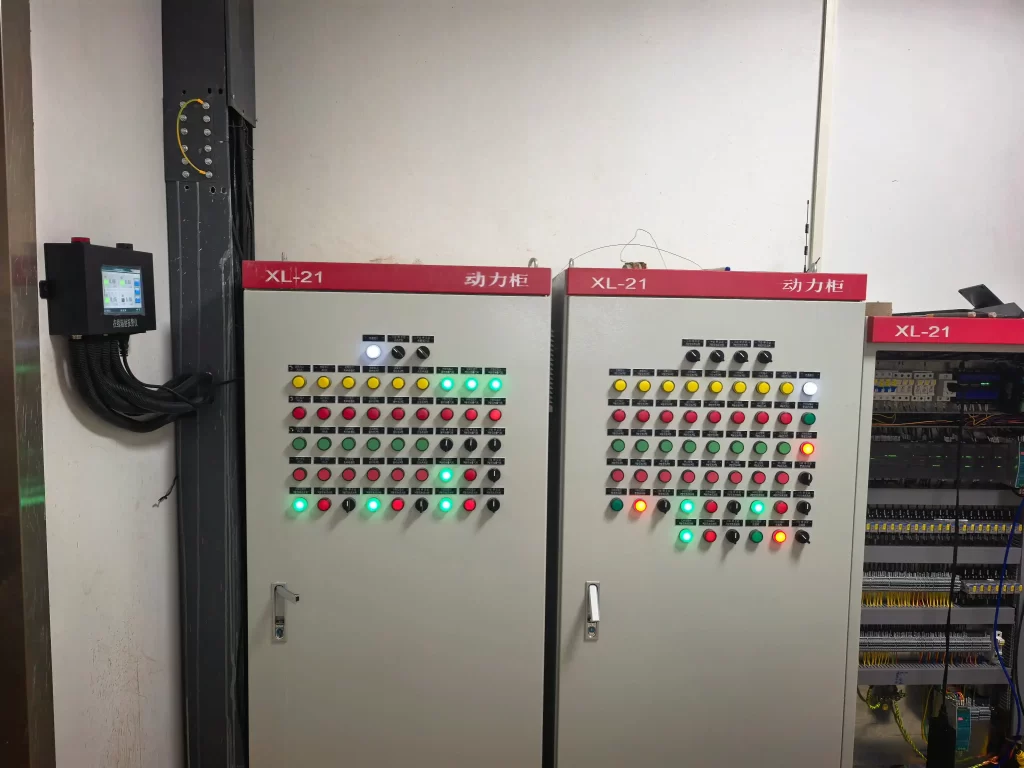
The layout of the control cabinet inside the equipment room is shown in the figure above. The black main unit of the radioactive liquid effluent radiation monitoring system can be seen at the upper left.
YD-890 Radioactive Liquid Effluent Radiation Monitoring System
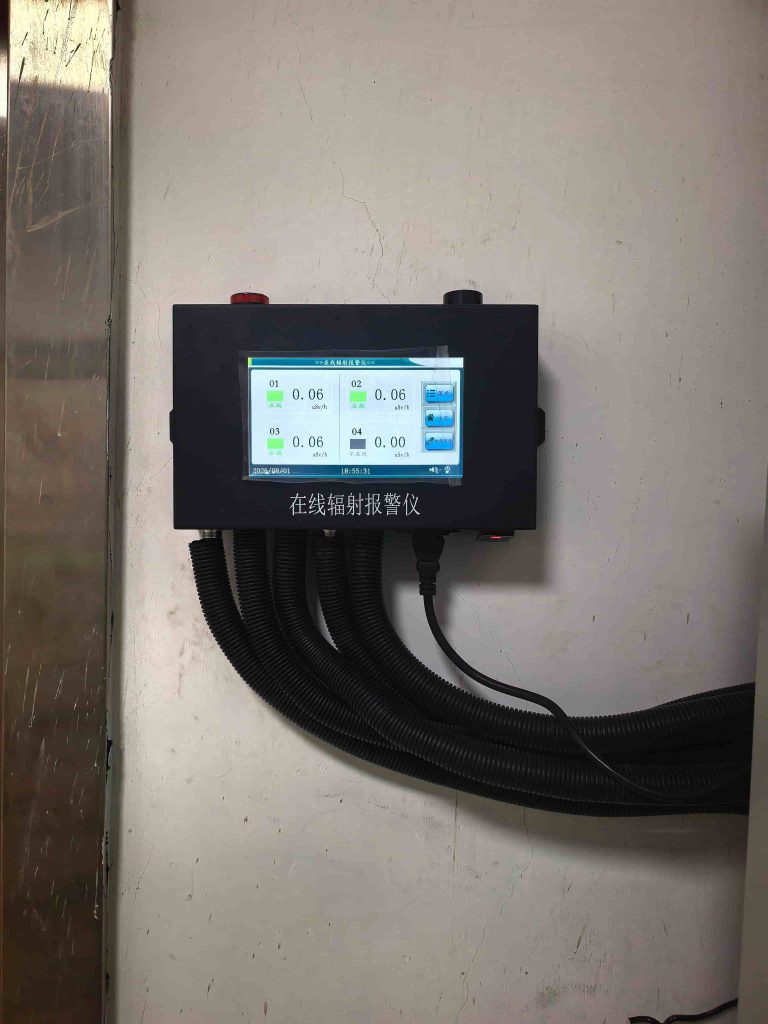
In this system, the radioactive liquid effluent radiation monitoring system is equipped with four GM radiation detectors, three of which are waterproof submersible radiation detectors, and the remaining one is used to monitor the environmental gamma dose rate. The monitoring data are transmitted in real time to the central control system platform via the Modbus protocol.In this system, the radioactive liquid effluent radiation monitoring system is equipped with four GM radiation detectors, three of which are waterproof submersible radiation detectors, and the remaining one is used to monitor the environmental gamma dose rate. The monitoring data are transmitted in real time to the central control system platform via the Modbus protocol.
PLC Control System HMI Screen
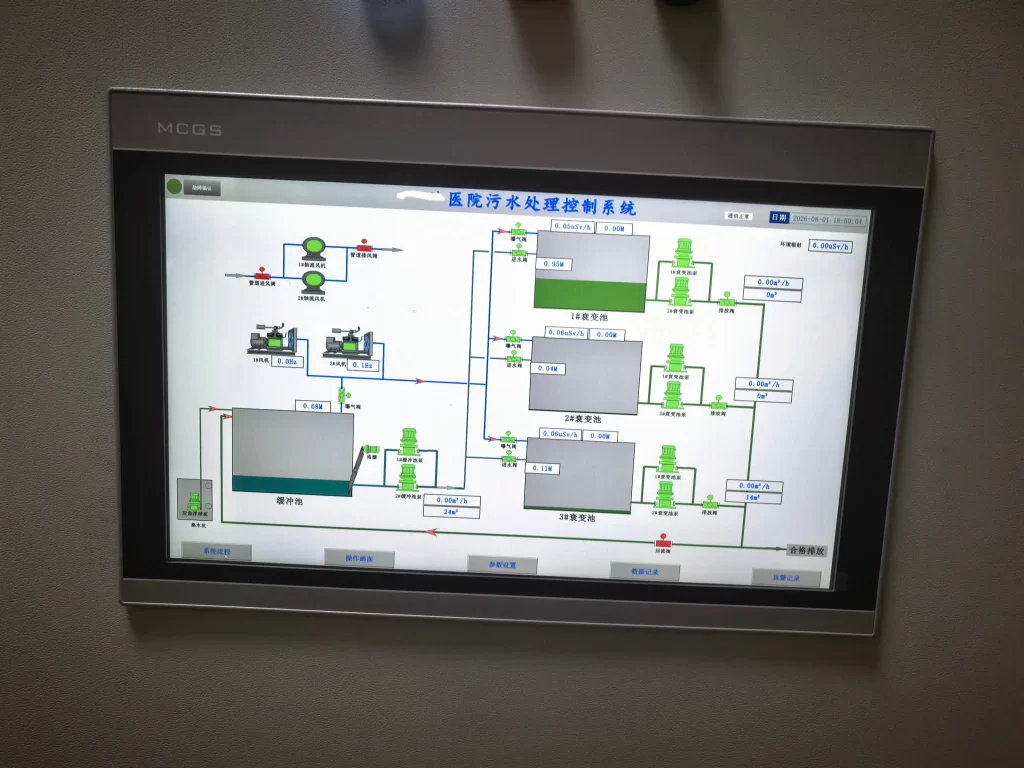
The PLC control system interface displays various real-time parameters, including the radiation dose rate data of each decay tank, the liquid levels, and the status of pumps, valves and other components. The overall project structure is well-integrated and fully meets the client’s on-site operational requirements.