
Overview
With the rapid advancement of nuclear technology and its widespread industrial application, a large number of hospitals, research institutes, NDT (non‑destructive testing) service providers, and factories now possess radioactive sources or ionizing radiation devices. These are used for purposes such as radiographic imaging, medical therapy, equipment calibration, industrial radiography, and thickness gauging. As illustrated in Figure 1, radioactive materials have become part of everyday life for the general public. It has therefore become an urgent priority to employ appropriate technical measures for effective regulatory control of radioactive sources — ensuring that source dynamics are properly recorded and traceable, and that radiological operations are prompt-guided and optimizable. This enables the protection of personnel, upholds the principle of keeping radiation doses “as low as reasonably achievable” (ALARA), and helps prevent radiological accidents and public concern.
Key Functions and Features (Customizable)
The system is designed to deliver a comprehensive set of capabilities for the life-cycle management and real-time surveillance of radioactive sources. These functions can be tailored to specific operational needs:
- High-Range γ/X Dose Rate Monitoring: Continuous, real-time measurement of ambient dose rates to ensure prompt detection of any abnormal radiation levels.
- Source Shielding Integrity Alarms: Immediate alerts upon the opening or failure of source shielding, ensuring that any unintended exposure is instantly flagged.
- Source Loss Detection: Automatic alarm generation in the event of a radioactive source being removed from its designated monitoring zone, addressing a critical nuclear security requirement.
- Environmental and Device Status Monitoring: Simultaneous tracking of ambient temperature and the operational health of the monitoring device itself.
- Proximity Detection: Real-time sensing of personnel approach, which can be used to trigger safety prompts or optimize operational procedures.
- Outdoor Mobility Tracking: Continuous location monitoring for devices and sources that are moved outdoors, ensuring traceability during field operations (e.g., mobile radiography).
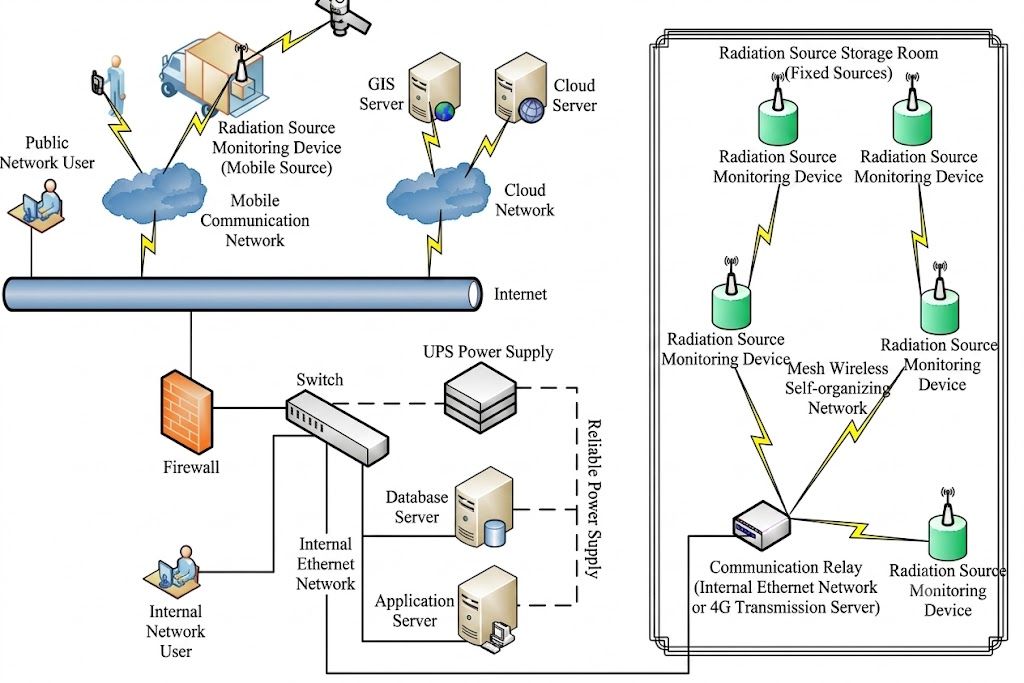
- High-Reliability Data Transmission: Robust wireless communication (4G and self-organizing mesh networks) ensuring data integrity and real-time connectivity under challenging field conditions.
- Integrated Data Platform: Centralized display, secure storage, and intelligent analysis of all real-time monitoring data from multiple sensor nodes.
- Historical Data Visualization: Intuitive graphical query and analysis tools for historical trends, supporting both safety audits and operational optimization.
- Geofencing: Configuration of virtual perimeters (electronic fences); the system triggers an alarm immediately if a source breaches its authorized zone of use or storage.
- Source and Device Inventory Management: Digital management of the entire lifecycle of radioactive sources and associated monitoring equipment, including check-in/out operations, thus enhancing accountability.
- Remote Configuration: Over-the-air (OTA) remote setting of device operational parameters, reducing the need for physical intervention and associated occupational exposure.
Overall System Topology Diagram
For further details, please feel free to contact us.